 Image 1 of 1
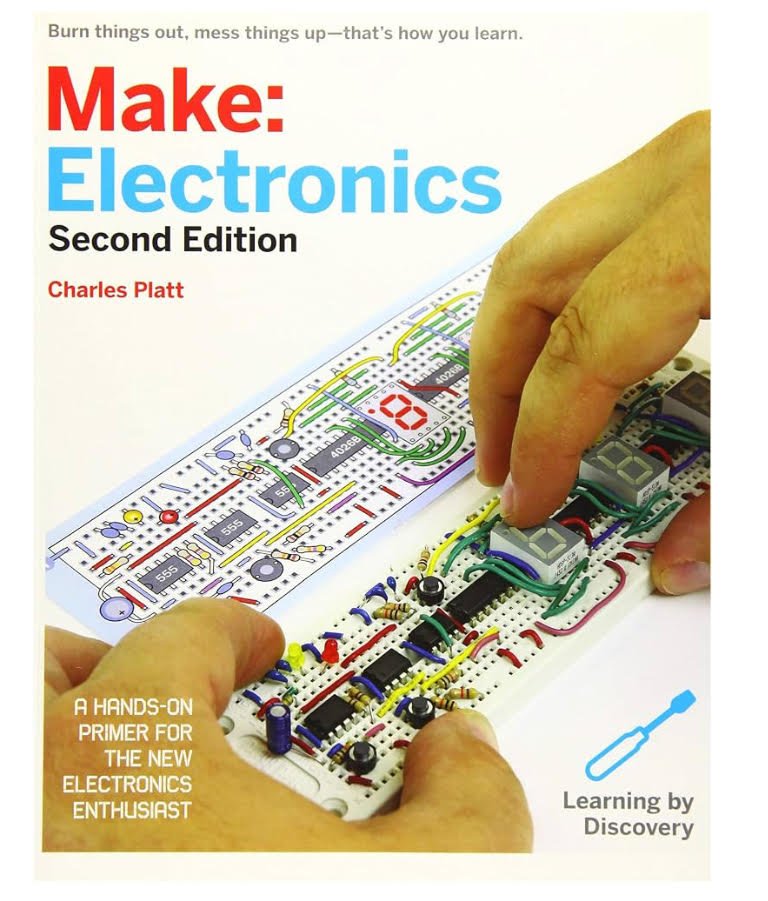
Make: Electronics, Second Edition sets a high bar for beginner-friendly electronics books and then raises it further. Every page is in full color, with hundreds of clear photographs and diagrams that make concepts easy to grasp.
Charles Platt teaches through doing. You build real circuits from the start, beginning with deliberately blowing a fuse or burning out an LED so you can see voltage, current, and resistance in action. The book’s spirit is summed up in its motto: burn things out and mess things up—that’s how you learn.
You progress to simple switching circuits and even open up a sealed relay to watch the mechanism work. Distinctive three-dimensional illustrations show exactly how parts plug into a solderless breadboard. A basic circuit demonstrates how a capacitor stores and releases charge. Theory is kept to a practical minimum, yet you’ll still learn Ohm’s Law and how to calculate a capacitor’s time constant.
A practical buying guide covers essential low-cost tools (pliers to multimeters) and shows common components such as transistors and capacitors in clear color photos so you can recognize them at a glance. A simple “finger test” illustrates how transistors switch or amplify current. From there you build working projects that produce light and sound, culminating in a straightforward intrusion alarm.
Three chapters walk you through soldering and creating permanent circuits, though soldering is optional for most of the book’s other projects. You’ll also explore integrated circuits—how they function, how they’re labeled, and where to buy them—then construct oscillators, one-shot circuits, and chains of timer chips.
Additional projects include a reaction-time tester, a computer combination lock, a competitive button-press game, and a simplified electronic dice circuit. The book offers practical advice on setting up a work area, storing parts, and choosing extra tools if you want to go further.
Later sections introduce inductance and components that rely on it, such as loudspeakers and a simple AM radio. The final chapters cover microcontrollers with hands-on Arduino projects.
A shopping list keeps part costs low, and ready-made kits from independent suppliers contain exactly what you need for the projects.
Written for absolute beginners, the book explains every idea carefully, patiently, and with a sense of fun. Readers from age 8 to 84 have praised it, and more than 200,000 copies have been sold. If you’re looking for a single, highly approachable introduction to electronics, this is an excellent choice.
Make: Electronics, Second Edition sets a high bar for beginner-friendly electronics books and then raises it further. Every page is in full color, with hundreds of clear photographs and diagrams that make concepts easy to grasp.
Charles Platt teaches through doing. You build real circuits from the start, beginning with deliberately blowing a fuse or burning out an LED so you can see voltage, current, and resistance in action. The book’s spirit is summed up in its motto: burn things out and mess things up—that’s how you learn.
You progress to simple switching circuits and even open up a sealed relay to watch the mechanism work. Distinctive three-dimensional illustrations show exactly how parts plug into a solderless breadboard. A basic circuit demonstrates how a capacitor stores and releases charge. Theory is kept to a practical minimum, yet you’ll still learn Ohm’s Law and how to calculate a capacitor’s time constant.
A practical buying guide covers essential low-cost tools (pliers to multimeters) and shows common components such as transistors and capacitors in clear color photos so you can recognize them at a glance. A simple “finger test” illustrates how transistors switch or amplify current. From there you build working projects that produce light and sound, culminating in a straightforward intrusion alarm.
Three chapters walk you through soldering and creating permanent circuits, though soldering is optional for most of the book’s other projects. You’ll also explore integrated circuits—how they function, how they’re labeled, and where to buy them—then construct oscillators, one-shot circuits, and chains of timer chips.
Additional projects include a reaction-time tester, a computer combination lock, a competitive button-press game, and a simplified electronic dice circuit. The book offers practical advice on setting up a work area, storing parts, and choosing extra tools if you want to go further.
Later sections introduce inductance and components that rely on it, such as loudspeakers and a simple AM radio. The final chapters cover microcontrollers with hands-on Arduino projects.
A shopping list keeps part costs low, and ready-made kits from independent suppliers contain exactly what you need for the projects.
Written for absolute beginners, the book explains every idea carefully, patiently, and with a sense of fun. Readers from age 8 to 84 have praised it, and more than 200,000 copies have been sold. If you’re looking for a single, highly approachable introduction to electronics, this is an excellent choice.